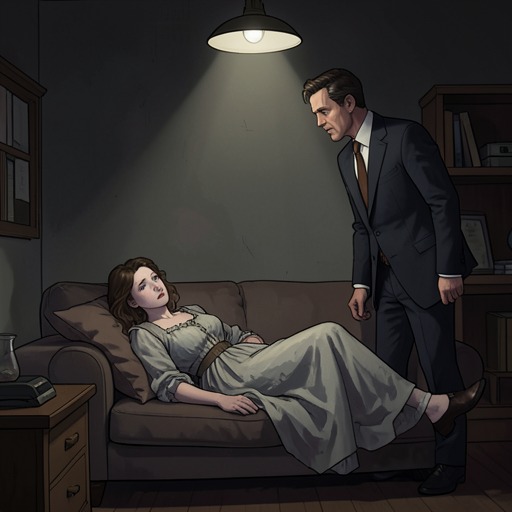
General Sternwood—Carmen Sternwood
The Big SleepGeneral Sternwood’s relationship with Carmen Sternwood is defined less by direct exchanges between father and daughter than by the protective secrecy surrounding them. Carmen and Vivian fear that the General, already gravely ill, will learn what Carmen has done; their attempt to spare him becomes a family obligation that shields him while concealing the truth about his daughter.
Family and Vulnerability
The General is a wealthy but physically diminished father. When Philip Marlowe visits him, Sternwood describes himself as paralyzed in both legs, with severely limited ability to eat and sleep. He presents himself as a remnant of an extravagant life, dependent on warmth and surrounded by orchids. His condition gives the daughters’ concern a concrete urgency: in Vivian’s account, disclosure would not simply wound his pride but might bring about his death.
Vivian makes the family bond explicit when she explains why she worries about her father. She says that Carmen is all she worries about, while she worries about the General in order to keep things from him. She identifies the source of the conflict as their shared inheritance: they are his blood, and the family’s history, once wild but not always rotten, is something she does not want him to condemn at the end of his life. Her words connect filial loyalty to the fear that the General will die despising his own daughters.
The Secret About Carmen
The concealed truth is that Carmen killed Rusty Regan. Vivian tells Marlowe that the General did not know. When Carmen returned and described what had happened, Vivian judged that her sister was not well and feared the police would draw the story out of her. She also believed Carmen might eventually boast about it. The threat to the General was therefore not only the crime itself but the prospect that he would hear the full account from Carmen or the authorities.
Vivian says she concealed the truth because she imagined the General would immediately tell the police if he knew, and that he would then die thinking about what had happened. She distinguishes this feared final knowledge from death itself: what mattered to her was the thought he would carry as he died. She adds that she did not love Rusty and that, in her own reckoning, his death mattered less than keeping the truth from her father. The confession exposes the severity of her family loyalty and the moral cost she is willing to accept for it.
Protection and Its Cost
Vivian’s concealment does not keep the crisis contained. She admits that she went to Eddie Mars for help and that he would exploit her financially, but says she felt she had no alternative. She had hoped Carmen might forget what happened during one of her episodes; at other times, Vivian says, she had difficulty believing the truth herself and turned to alcohol. Her protection of the General thus depends on a series of evasions that leave Carmen at large and Vivian vulnerable to Mars’s demands.
Marlowe confronts Vivian with that consequence, arguing that Carmen has been left free to become involved in further trouble. He does not simply demand disclosure to the General. Instead, he tells Vivian to take Carmen far away, somewhere equipped to keep weapons and other dangers from her and to care for her; he allows that treatment might help. Vivian’s acceptance of this demand recasts protection as practical care, rather than continued secrecy alone.
A Relationship Mediated by Silence
The General’s relationship with Carmen is largely mediated by what others withhold from him. Marlowe says that he has been protecting a sick, broken old man’s remaining pride and his belief that his daughters are not killers. Vivian’s account shows the intimacy and danger of that strategy: she wants to spare her father, but her silence also prevents him from knowing the truth about Carmen and from responding to the family crisis directly.
At the novel’s close, Marlowe imagines the General waiting in his bed, his heart uncertain and his thoughts dimming, while death approaches. That image links the father’s physical decline to the secret kept around him. His relationship with Carmen is not resolved through a direct reckoning; it remains suspended between Vivian’s love and fear, Carmen’s need for care, and the truth withheld from the father they are trying to protect.